
Wednesday, 26 August 2020

Tuesday, 25 August 2020
3.2 Advanced Level Brief Option 2: Film Promotion package Film Trailers
AMERICAN SNIPER
HOW THE FILM CREATES A SENSE OF GENRE
American Sniper is a biographical war film based loosely on real events and directed by Clint Eastwood. The trailer has a slow build which clearly demonstrates an interior narrative of the throught process of the sniper when under pressure in the battlefield. The trailer immediately offers the viewer a clear sense of genre which has been created by multiple soldiers prone on a rooftop with snipers. This conveys to the audience that the film is an action/war movie; however, with the scenes being divided into parallel events, linked through cross-cutting and fades to black we understand there is a very strong sub story to this film. During the opening seconds of the trailer eerie silence with only the sound of breath strongly suggests the film will contain drama or potentially turn out to be a thriller.
HOW THE FILM INTRODUCES THE CENTRAL CHARACTER and CONFLICT
The conflicting emotions of the central character are made very clear immediately. Chris Kyle (Bradley Cooper) is a sniper, evidently the 'American Sniper' of the title; he is the main character within the film, but the trailer develops him in two roles. The main conflict is split between the obvious narrative of terrorism in Iraq, and the risk of punishment if any wrong decision on the battlefield is made. Cross-cutting and fades to black links the narrative between the sniper’s private joy in his family life and his duty as a soldier which may require him to destroy someone else’s family.
HOW DOES THE TRAILER TEASE THE AUDIENCE WITH SUGGESTIONS OF ACTION? HOW IS SOUND USED?
Pulsating sound beats and fades to black create visual and instrumental tension. There is a "will he won't he" opening scene which suggests action will occur rightly or wrongly. The cut is finished with a man on the radio saying 'your call'. This means that the decision to kill a potentially young terrorist is in his hands and he is told that he will be 'fried' if he makes the wrong call. Sound bridges link the two ‘lives’ that he leads throughout the trailer over scenes such as the birth of his child. This is significant as the viewer is able to recognise the tension in the heat of the moment and humanise the main character. The tense music, heavy breathing and communication over memorable times away from his job allows for the scene to be portrayed as much more powerful as the scene is significant to Chris Kyle himself.
HOW EDITING INTENSIFIES THE PACE
Rapid cutting and fades to black with sound edits are used between shots that display private family joy and drama, such as his marriage, child’s birth, interlinked with a juxtor position war zone. It is very clear from the trailer that a decision needs to be made which could threaten his career. There is an extremely obvious increase in pace throughout the editing which heightens the tension. The sound of a pulsating heart beat is present and increases in pace as tension builds. Before he is required to make the decision to shoot down a mother and her son, there is rapid cutting and flashes of his life outside the military with his child, wife and friend in hospital. This adds to the existing tension as it involves his personal life and his professional life which appears to be on the line. A dramatic crescendo is created as tension and drama increases rapidly until the end of the trailer. There is no clear music throughout the duration of the trailer. However, there is an ever present score which gradually becomes louder as the heartbeat increases. This allows for a dramatic affect to be created as the suspense of the trailer becomes more intense.
OTHER TRAILER CONVENTIONS
The trailer uses inter titles to advertise star talent – Bradley Cooper. A further inter-title of the single line ‘The most lethal sniper in U.S. history’ establishes the historical and biographical element and lends a seriousness and authenticity to the trailer. The film’s title also displays social media links. Two busy screens then show Warner Bros, the director and other talent like Sienna Miller.
HOW THE FILM CREATES A SENSE OF GENRE
The trailer for Gravity immediately creates the sense of genre from the very first few frames we see. From the black frames and the stillness with no sound comes the visual explanation by way of text that describes the film. This alone could serve as a tease to the movie as a stand-alone. “372 miles above the earth, there is nothing to carry sound, no oxygen, no air pressure. The text then tells us that ‘life in space is impossible’. We realise pretty quickly this film is indeed set in outer space and we understand early on that something catastrophic is about to happen. At precisely about 11 seconds into the trailer the silence is abruptly broken with a crashing sound effect and we see visuals of a space shuttle being hit by high speed travelling debris. Visually this creates an impactful change in pace and escalates in intensity. It is a movie about space and the premise of the movie is one of a disaster film. Computer generated imagery (CGI) is used to create the strong sense of genre in a film that would be impossible to create naturally. The costumes and the space shuttle all add to the clear-cut genre of this movie.
HOW THE FILM INTRODUCES THE CENTRAL CHARACTER and CONFLICT
HOW DOES THE TRAILER TEASE THE AUDIENCE WITH SUGGESTIONS OF ACTION? HOW IS SOUND USED?
Sounds at this stage become broken, fast, chaotic and frantic. It replicates the sound and pace of a thumping heartbeat. It’s a frightening situation we are now in and this is cleverly sound engineered with screams of helplessness from the main character. We also hear the space station at a more distanced level offering instruction in an impossible situation. There are two levels of sounds. A present level as in the character screaming and out of complete control and a level that represents the space station that is clearly out of scene and range, it sounds distant. Dialogue isn’t particularly clear but it doesn’t need to be in the early stages of the trailer. It’s important that we feel out of control like the characters we are watching, so picking up clear dialogue at this stage isn’t important. The sense of the impossible situation with the menacing drone underneath is enough to grasp what is going on.
The CGI controls the pace and mood of this trailer more so than the actual editing. Unusually up until 45 seconds into the trailer there are very few edits made considering the action packed visuals we the viewer see. Beyond 45 seconds we see more of the editors role take place with dramatic fades to blacks punctuated with sound effects and fast paced editing sequences which cross cut the parallel stories behind this film. There is great use of fades to black which is often used in thrillers and the pace and energy of editing makes you slightly feel out of breath which works given the nature of the story.
OTHER TRAILER CONVENTIONS
Friday, 3 July 2020


Sunday, 14 June 2020
RESEARCH: HOW IS THE CAMPAIGN COSTED?
ABOVE THE LINE COSTS:
These are known costs for creating marketing material, buying media advertising and creating an online presence for the film itself.
BELOW THE LINE COSTS:
Publicity builds further awareness and interest in a film- and authored articles or editorial interviews are something more 'trusted' than display advertising, which is paid for.
Wednesday, 10 June 2020
RESEARCH: WHO IS THE TARGET AUDIENCE?
To guide me to finding my target audience, I utilised the FDA website where there were two film experts; Kezia Williams and Chris Besseling who had concise, informative guidance which helped me to find my target audience.
On the FDA website, Kezia Williams, Head of Theatrical Distribution at Entertainment One UK, explains that defining the target audience will affect the ‘where’ and ‘how’ of the marketing campaign;
For example: 'Where should the distributors promote and advertise their film on social media?' and 'how should they would promote the film to appeal to and to engage their target audience?'
Kezia Williams explains, in the video, that distributors will start to define their audiences by comparing other films with their films.
Who is the target audience?
Kezia Williams
Research -
Kezia Williams
Research -
- Bespoke research, focus groups, interviews with potential audience
- If the film is based on a book or a film there is already existing data of the audience to access that can be used when targeting the film to an audience
- Talent: if theres actors that appeal to a certain audience
- Core audience must be identified before looking at the audience that could show interest in the film
- Some films have multiple target audiences
Chris Besseling -
Research
Research
- Anomalies at the box office such as surprise hits make research into target audiences even more important
- Historical data is used to give the 'green light' (OK) for a project
- First strategy is comparing lists of titles that have subtle links with the film - actors, directors, genres and subject matter. This is used to find out the target audience brief.
- Historical fame data is to discover the target audience - age, gender and socio-economic standing which gives an overview of who the audience is likely to be and who should be targeted
- How comp titles perform at the box office is another important factor to consider - this influences how much will be spent on P&A
INTRODUCTION TO TRAILERS
HOW DO YOU FIND OUT ABOUT A FILM?
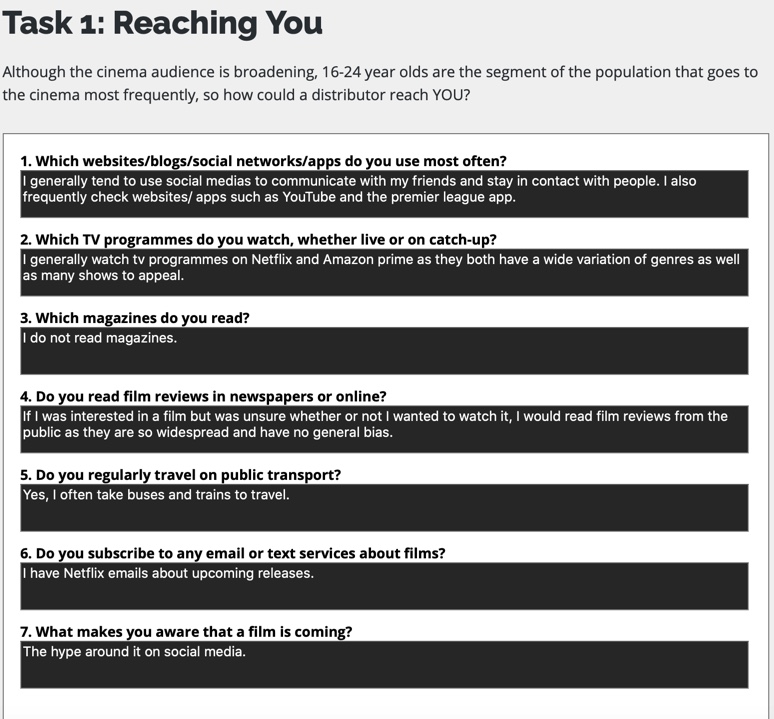
Normally, I tend to see an ad somewhere. whether this be on the radio or on TV. If the movie appeals to me, I will go further and research it online, e,g searching for a release date, watching trailers etc. For example, I found out about the movie Star Wars: The Rise of Skywalker on the radio. Suddenly after, I saw social media posts about it. All these led me to eventually purchase a ticket to watch the movie.
WHAT MAKES YOU WANT TO SEE A FILM?
Actors and storyline play a significant role when sparking my interest. Specific actors are able to make me want to see a specific movie upon release as it is able to trigger my interest. With Adam Sandler being one of my favourite actors, I generally enjoy watching his films specifically due to my interest in his strange humour.
HOW DO YOU KNOW WHAT TO EXPECT FROM A FILM?
Generally, you are able to know what to expect from a trailer if it is clear. Genre is also extremely important. You can understand what you are viewing completely off genre. You can see the movie as and action and adventure rather than a horror. With some films, you are unable to tell if it is a certain genre as there are multiple recurring themes. For example, I found it difficult to tell if 'The Woman in Black' was a horror, ghost or spooky film. With the themes in the film I personally would not associate with horror and rather with Sci-Fi and supernatural.
WHAT AM I PAYING FOR WHEN I BUY A CINEMA TICKET?
When paying for a cinema ticket, I believe it is mostly paying for the viewing experience rather than the movie itself. Viewing the movie in a cinema setting is much more immersive and allows for the movie to be viewed in higher resolution, on a bigger screen, with Dolby surround sound.
ARE THERE FILMS I HAVE TO SEE IN CINEMA OR DOES IT NOT REALLY MATTER?
Some franchises do work better on a wider screen. I have found my watching experience is better in the cinema when I am watching a Marvel movie, because the action sequences contain so much detail. However, you don't miss much by watching at home, and it is definitely personal preference.
Normally, I tend to see an ad somewhere. whether this be on the radio or on TV. If the movie appeals to me, I will go further and research it online, e,g searching for a release date, watching trailers etc. For example, I found out about the movie Star Wars: The Rise of Skywalker on the radio. Suddenly after, I saw social media posts about it. All these led me to eventually purchase a ticket to watch the movie.
WHAT MAKES YOU WANT TO SEE A FILM?
Actors and storyline play a significant role when sparking my interest. Specific actors are able to make me want to see a specific movie upon release as it is able to trigger my interest. With Adam Sandler being one of my favourite actors, I generally enjoy watching his films specifically due to my interest in his strange humour.
HOW DO YOU KNOW WHAT TO EXPECT FROM A FILM?
Generally, you are able to know what to expect from a trailer if it is clear. Genre is also extremely important. You can understand what you are viewing completely off genre. You can see the movie as and action and adventure rather than a horror. With some films, you are unable to tell if it is a certain genre as there are multiple recurring themes. For example, I found it difficult to tell if 'The Woman in Black' was a horror, ghost or spooky film. With the themes in the film I personally would not associate with horror and rather with Sci-Fi and supernatural.
WHAT AM I PAYING FOR WHEN I BUY A CINEMA TICKET?
When paying for a cinema ticket, I believe it is mostly paying for the viewing experience rather than the movie itself. Viewing the movie in a cinema setting is much more immersive and allows for the movie to be viewed in higher resolution, on a bigger screen, with Dolby surround sound.
ARE THERE FILMS I HAVE TO SEE IN CINEMA OR DOES IT NOT REALLY MATTER?
Some franchises do work better on a wider screen. I have found my watching experience is better in the cinema when I am watching a Marvel movie, because the action sequences contain so much detail. However, you don't miss much by watching at home, and it is definitely personal preference.
RESEARCH: WHAT SETS A FILM APART?

Unique selling points are important in setting the film apart from others in its genre:
Types of selling points:
- Cast
- Well-known director
- Quality of the performances
- Reviews
- Awards
- Films source material - based on a true story, a real person, a book or part of a franchise/sequel
- When making a sequel you automatically have a built in audience that you can cash in on

Subscribe to:
Posts (Atom)
-
 American Sniper HOW THE FILM CREATES A SENSE OF GENRE American Sniper is a biographical war film directed by Clint Ea stwood. The trailer i...
 -
annabelle by The Hong Kong Files Movie